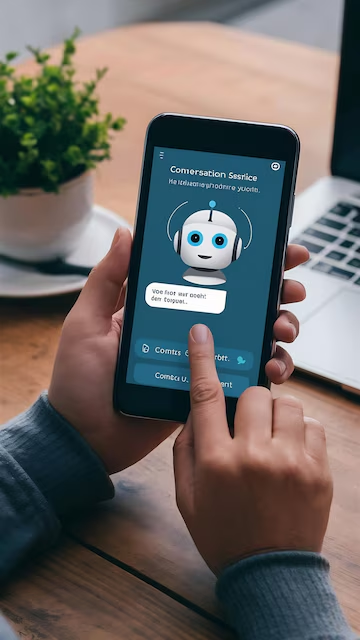
The Dual Face of Artificial Intelligence in Data Protection and Privacy

Project Overview

AI is reshaping data privacy—enhancing protection while raising ethical concerns. This case study outlines how a cybersecurity firm partnered with key industries to implement AI-based frameworks focused on threat detection, encryption, and compliance—while ensuring responsible data use.

The challenge

1. AI Tools Misused for Data Exploitation

While AI can secure data, it’s also used by bad actors to mine personal data from social media, browser cookies, and IoT devices. Clients struggled to detect AI-driven social engineering, especially in the finance sector.

2. GDPR & Compliance at Scale

Manual compliance with GDPR, HIPAA, and other data protection laws was time-consuming and error-prone. With millions of customer data points, real-time consent management and right-to-be-forgotten enforcement became nearly impossible without AI — yet ironically, using AI raised its own trust concerns.

3. Data Lakes with No Visibility

Organizations had large, unstructured “data lakes” with little oversight. Sensitive data, such as patient info or transaction logs, could be accessed or copied without traceability, creating privacy and security vulnerabilities.

4. Bias and Black-Box AI Models

Some AI security tools used in fraud detection or access control showed unexplainable behavior — blocking legitimate users or disproportionately flagging certain groups, sparking legal and ethical challenges.

The Solution

1. AI-Powered Anomaly Detection System

DataNova deployed deep-learning algorithms that scanned live user behavior patterns across platforms. The AI flagged anomalies in login location, session timing, data download size, and access frequency — helping catch breaches before they escalated.

2. Privacy-Aware Encryption & Tokenization

All sensitive fields (e.g., health IDs, credit scores, device fingerprints) were automatically encrypted or tokenized during storage and transit using AI classifiers that tagged risky attributes. This also enabled selective access for teams, reducing human error exposure.

3. AI-Driven Consent Engines

An interactive privacy dashboard allowed customers to view, modify, or revoke data permissions at any time. The AI auto-managed cookie banners, personalized consent forms, and data usage logs — ensuring 24/7 regulatory compliance across regions.

4. Ethical AI Auditing Framework

DataNova built a transparent AI audit trail system. Every decision made by AI — whether it was denying access, reporting a breach, or flagging a transaction — was logged, explainable, and reversible, allowing clients to remain legally compliant and ethically accountable.


Results

1. 70% Faster Breach Detection and Response

With AI monitoring in place, the average time to detect and contain unauthorized data access dropped from 28 hours to under 8 hours, significantly minimizing damage in breach scenarios.

2. 95% Regulatory Compliance Automation

Tasks like cookie policy generation, consent logs, data deletion confirmation, and user notifications were automated — saving 40+ manual hours per week per organization.

3. 15% Higher User Trust Scores

Clients using the new privacy dashboard reported a 15% increase in customer trust and retention, thanks to clear data usage transparency and opt-out options.

4. Bias Identification in AI Models

Using the ethical audit system, one hospital uncovered racial bias in its AI triage tool — enabling timely retraining of the model and a public commitment to fairness in patient care.

Future Outlook

DataNova aims to further evolve its AI privacy suite by:

Introducing zero-trust AI access layers — where AI itself cannot access full data without dynamic authorization

Developing federated AI learning for clients who want secure, local data training without cloud transfer

Collaborating with EU watchdogs to define the AI Data Ethics Certification Protocol

Launching AI bias simulators — tools that allow companies to test if their AI decisions could cause unintentional privacy harm or discrimination

Building real-time “privacy scorecards” for end-users based on how their data is handled across touchpoints

The Dual Face of Artificial Intelligence in Data Protection and Privacy

Related Case Studies

expert 200+
Experts

Do not hesitate to contact us to ❤️ say hello.

(+91) 8800464848

Engage with our network of experts